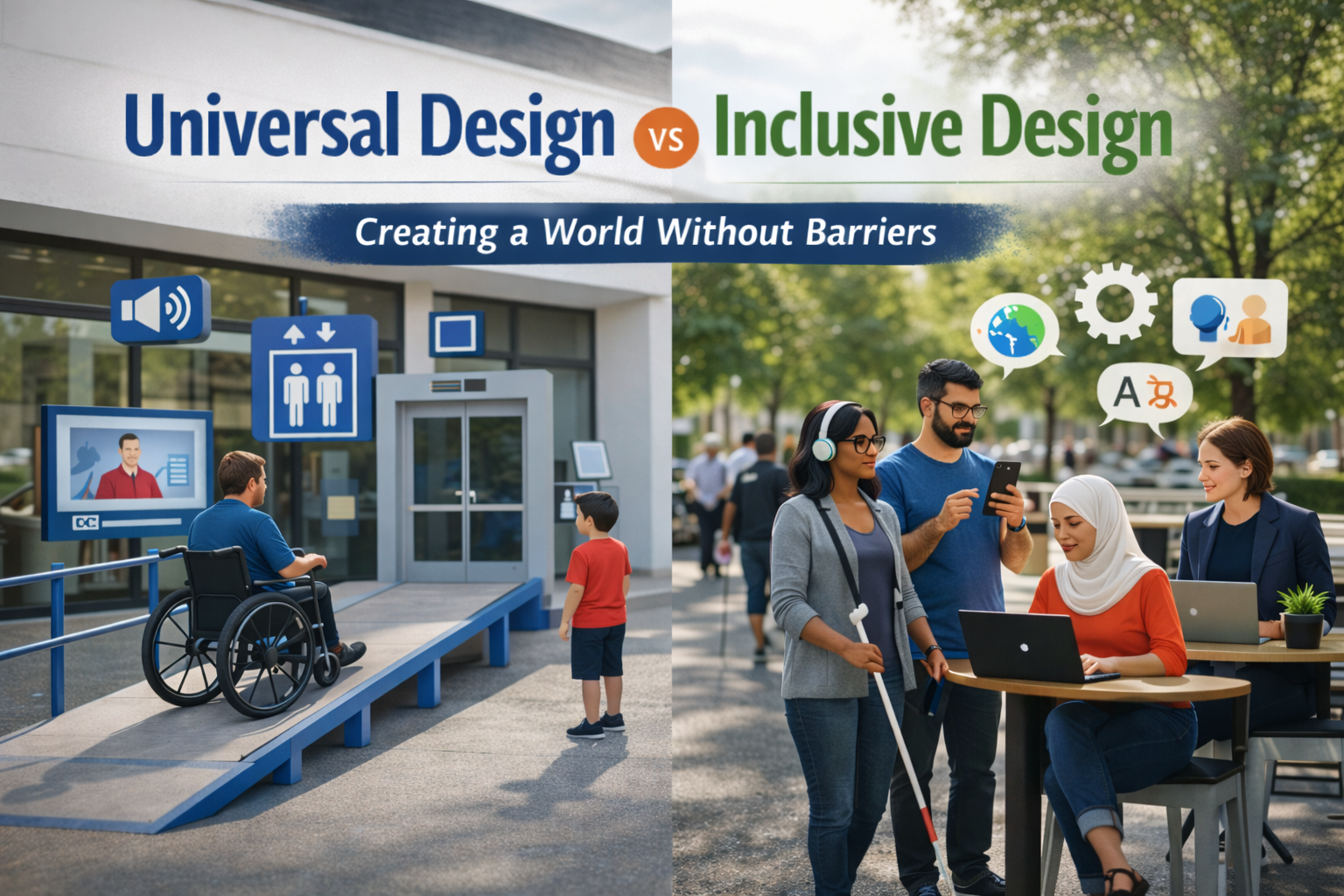
Universal Design vs Inclusive Design: Creating a World Without Barriers
When we discuss accessibility, it is very easy to limit our discussion to websites and applications.
However, accessibility is a much broader concept that encompasses physical environments, products, services, and digital interfaces of all aspects of life where design can either include or exclude them.
Universal design and inclusive design are two very effective strategies for barrier removal. These two strategies are not opposing each other; instead, they complement each other in the common goal of designing for everyone.
Let’s discuss what each of these strategies entails, how they differ from each other, and why both of them are important in creating a fully accessible world.
Universal Design: Designed for Everyone, Right from the Start
What Is Universal Design?
Universal Design is the concept of designing spaces, products, and systems that can be accessed and used by everyone, to the maximum extent possible, without any need for adaptation or specialized design.
The Seven Principles of Universal Design
The following are a set of principles that were developed by a collaborative group of architects and designers. The principles act as a guide for universal design:
- Equitable Use: The design is equally valuable and marketable to a broad range of users regardless of their abilities.
- Flexibility in Use: The design can accommodate a broad range of user preferences and abilities.
- Simple and Intuitive Use: The design is simple and easy to use.
- Perceptible Information: The design conveys information to users effectively regardless of their sensory abilities.
- Tolerance for Error: The design minimizes the possibility and consequences of user error.
- Low Physical Effort: The design is comfortable and requires minimal physical effort.
- Size and Space for Approach and Use: The design is appropriate for users of all body sizes and mobilities.
Examples in the Physical World
- Ramp entrances alongside stairs
- Lever-style door handles, which are easier to grip than knobs
- Audible and visual signals for pedestrian crosswalks
- Counters in kitchens and workspaces that have adjustable height settings
- Tactile paving for visually impaired pedestrians
Inclusive Design: Designing with People, Not Just for Them
What Is Inclusive Design?
Inclusive design is based upon the clear recognition of human diversity and the need to understand and meet the requirements of people who often find themselves in marginalized positions because of their disability, age, language, culture, or other contextual issues.
Rather than providing the "right" answer, inclusive design is based upon the need for flexibility, personalization, and participation.
Core Mindsets of Inclusive Design
- Design with excluded communities: Work with these groups throughout the design process.
- Remove points of exclusion: Identify and eliminate the barriers to inclusion.
- Offer choice and control: Ensure that people can modify the experience to suit their requirements.
- Take the Whole Real-World Context into Account: Ensure that the design is relevant to the "real world."
Some Exemplary Inclusive Design Solutions in the Physical Environment
- Modular furniture layouts that can meet the requirements of people with different abilities
- Multilingual signage with the use of symbols and braille
- "Quiet hours" in retail spaces for sensory-friendly shopping
- Adjustable lighting and acoustic conditions in public spaces
- Workspaces that can support the use of assistive technologies, such as accessible power sockets and variable-height desks
Universal vs Inclusive Design: Side-by-Side View
| Aspect | Universal Design | Inclusive Design |
|---|---|---|
| Goal | One design that works for everyone | Design that adapts to diverse needs |
| Approach | Top-down, principle-led | Bottom-up, human-led |
| Focus | Broad accessibility from the outset | Eliminating specific points of exclusion |
| Outcome | Consistent, integrated solution | Flexible, often customizable solutions |
| Physical Example | Sliding automatic doors | Height-adjustable desks with multiple user presets |
The Business and Social Impact
Combining these two design approaches is not only good business ethics, but it is also good business strategy, considering the following advantages:
- Expanded Accessibility: Tap into over one billion people worldwide living with disabilities, as well as aging populations and their families.
- Innovation driver: The constraints will force us to think outside the box, leading to solutions that can benefit everyone, not just people with disabilities (for instance, ramps can accommodate not only wheelchair users but also parents with strollers, travelers with luggage, etc.).
- Future-Oriented Compliance: Meet and exceed requirements set by the UN CRPD, ADA, RPWD Act, etc.
Build an empathetic brand: Demonstrate your long-term commitment to true inclusion through all design modalities.
We at Inqlude work with organizations to integrate these design philosophies with various initiatives, including office settings, facilities, products, customer experience, etc.
Implementing Universal and Inclusive Design in Real Projects
- Empathy: Work with diverse user groups to develop solutions.
- Assess for Barriers: Audit exclusion points in existing design solutions to identify areas for improvement.
- Prototype with Flexibility: Develop solutions that can accommodate personalization.
- Real-World Evaluation: Test solutions to determine effectiveness in various settings with diverse users.
- Iterative Refining: Accessibility is an ongoing process, not an end state.
Conclusion: Dual Philosophies, Unified Objective
Universal Design sets the foundational and holistic solutions that are inclusive of the entire range of users. Inclusive Design adds the finer details that are required to make spaces inclusive of users on the periphery.
At the end of the day whether we are designing a park, a website, a product or a policy our goal is the same:
To create a world where everyone can participate fully and freely and without any barriers.
At Inqlude we believe in blending the best of both Universal Design and Inclusive Design to build spaces and experiences and systems that're truly for all people.
Great design doesn’t just look good, it feels right to everyone.
Ready to build accessibility into your next project?
Let’s create spaces and experiences that include everyone.
Contact us at
Email: info@inqlude.in
Phone: +91 8989683232