Usability vs. Accessibility: Two Key Parts of Good Product Design
Have you ever tried to fill out a form on your phone, only to find the "Submit" button was so tiny you kept hitting "Cancel" instead? Or maybe you’ve struggled to read light gray text on a white background while standing in the bright sun?
That is really frustrating, isn't it?
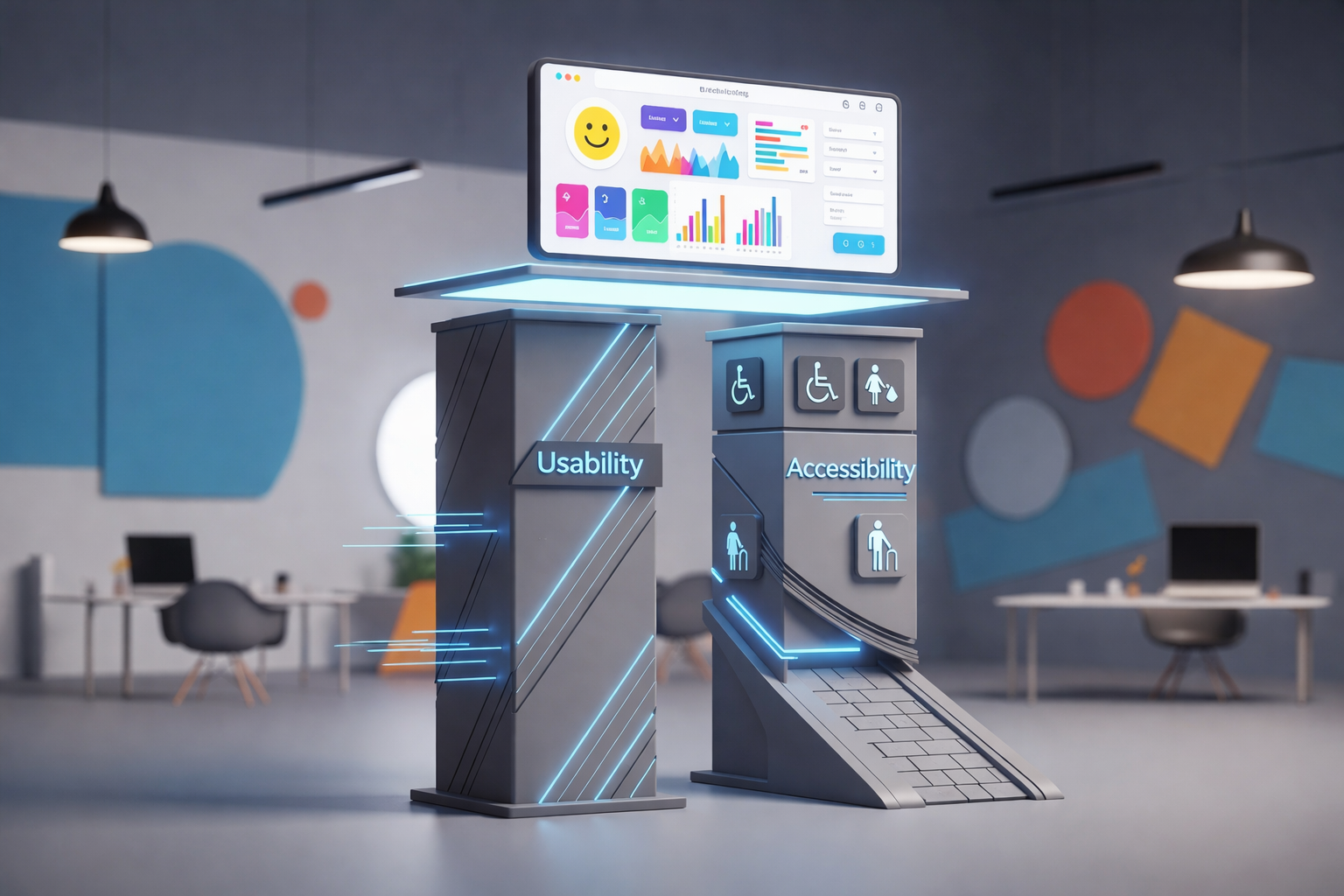
This frustration is where Usability and Accessibility come together. In the design world, we often hear these terms used as if they mean the thing. While they are related, they are ideas with different goals. Understanding the difference between them is important to build products that work well for everyone.
Pillar 1: Usability (The "Is this easy to use?" Factor)
Usability is like the smoothness of a ride. It's about how well something works, how efficient it is, and how satisfied you are with it. When a product is very usable, you don't even notice the design. You just get things done.
A usable product answers questions like:
- Can I find what I need quickly?
- Do I understand what this button does before I click it?
- Is the navigation logical and easy to follow?
If you're booking a hotel room and can filter by price, view photos, and confirm your reservation in three clicks, that's good usability. It's about making things easy for the user.
Pillar 2: Accessibility (The "Can anyone use this?" Factor)
If usability is about how good the experience's accessibility is, it's about whether everyone can have the experience at all. It asks: Can everyone use this product no matter their cognitive abilities?
Accessibility makes sure there are no barriers for people with disabilities. This includes:
- Visual impairments: Can a screen reader describe this image? Is the contrast high enough for someone with low vision?
- Motor impairments: Can this website be navigated using only a keyboard?
- Hearing impairments: Do videos have accurate captions?
- Cognitive differences: Is the content simple and distraction-free?
At Inqlude, accessibility is very important to us. We know that accessibility is not just a nice extra; it's a right. Like a ramp helps a wheelchair user enter a building, digital accessibility helps a screen-reader user join the digital economy.
The Magic Intersection: The "Curb Cut" Effect
Here's where things get interesting. Many people think that designing for accessibility limits creativity or makes a product clunky. The truth is the opposite.
Accessibility always makes usability better for everyone.
We call this the "Curb Cut Effect." Originally curb cuts were made for wheelchair users to cross the street safely. Who else uses them? Parents with strollers, travelers with luggage, skateboarders, and delivery workers. A feature designed for one need ended up helping everyone.
The same applies to digital products:
- Captions are essential for the deaf community, but they are also used by millions of people watching videos on the bus with the sound off.
- High-contrast text is vital for low-vision users, but it also helps you read your screen when you’re outside on a sunny day.
Simple, clear language aids users with cognitive disabilities, but it also helps busy professionals scan information quickly.
Why This Matters for Inqlude
For us, this is not just theory. Whether we are checking a hotel for access or testing a website for WCAG compliance, we see the impact of these two pillars every day.
When you ignore accessibility, you are not just making your product hard to use. You are excluding a part of the global population (over 1 billion people live with some form of disability). When you combine good usability with strict accessibility standards, you create something powerful: inclusion.
The Takeaway
So is it Usability vs. Accessibility? Not really. It's Usability and Accessibility together.
You can have a website that's accessible but a nightmare to navigate (technically correct but functionally terrible). You can have a beautiful, easy-to-use app that is completely invisible to a screen reader.
True design excellence happens when we stop treating usability and accessibility as checklists. Let's build products that are easy to use and make sure they are easy to use for everyone.
That's how we do things at Inqlude.
Ready to build a truly inclusive experience? If you want to connect, contact us today.